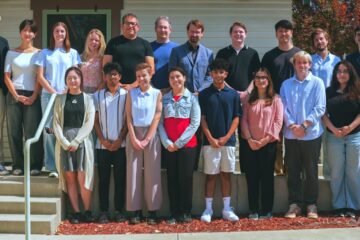
Victoria Esperanza Mena Perez
She/Her | Undergraduate Research Assistant
Victoria started at LUCID in June 2026. She is currently pursuing a bachelor’s degree in Health Science with an Applied Human Physiology area of study.
What are your research interests?
I’m currently trying to define that, but I can say I want to do something related to health and in the area of philosophy.
What drew you to LUCID?
I attended an open house meeting and I felt very welcome to the research team. This was during fall of freshman year, so I felt hesitant to start my research journey. I got involved in another lab on campus during my spring semester, but I missed the warmth of the LUCID lab. So I emailed Dr. Schurger at the end of spring, hoping for the best, and I luckily got accepted as a summer research assistant.
What’s your philosophy on AI?
I think AI is a resource that can be used dangerously. Many people become dependent, and it’s worrisome the amount of power it holds over people’s opinions. There has been an increase of dependency on the tool to the point of asking for psychological advice; it can seriously damage an individual’s mental health to rely on a machine instead of a medical professional or another person.
Overall, it’s a great resource as long it’s not used constantly to the point of dependence.
Can you describe a research study at LUCID that you have conducted or participated in?
I have been involved in the Dynamic Noise Stimulus study, which was created by a fellow undergraduate student: Eusabeia Silfanus. The study’s purpose is to understand how visual information is integrated over time. How it works is that a participant views a dynamic black-and-white visual noise. Then, a faint pattern (called a Gabor grating) may appear within the noise, tilted left or right. The participant’s role is to identify the direction of tilt and rate their confidence. The noisy image can update more or less rapidly depending on the calibration block.
My role includes assisting with participant recruitment, booking lab rooms, behavioral and non-invasive physiological data collection, data analysis, literature reviews, and lab management (like cleaning up the room after using it). By recruitment, I mean putting up around 30 flyers once a week on the main campus, Crean, and Dodge. Once a person sees the flyer, they contact me and I schedule a time to run the experiment. I take care of running the behavioral non-invasive study.
What’s something you’ve learned in your time at LUCID?
I learned how to work closely with a team. I was paired up with Yash Dalan, and this was my first time running something as an experiment with participants. I felt that I learned how to be responsible, like how to schedule and how to be mindful of participants’ time. I was the one who had to run the experiment, so the trust to let a newcomer do something like that was a shocker. I definitely felt that I was part of the team. I was expecting to be an observer, not to be an active member. I also emailed a lot of people, so I definitely got practice in email etiquette at the lab.
Can you share a fun fact about your specific field of study?
Your right side of your body is connected to your left hemisphere of the brain, and vice versa with the left side being controlled by the right hemisphere of the brain.
Can you share a fun fact about yourself?
When I was in high school, I participated in academic decathlon. In the speech section, I created one about how potatoes have been an important part of history, and I was one of the five people who got first place in that section. It was a blast!