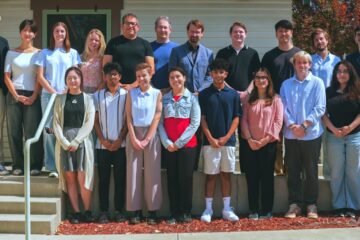
Yash Dalan
He/Him | High School Intern
Yash was an intern under Dr. Aaron Schurger during summer 2026. Now, as Yash enters his senior year of high school, he is exploring different career paths to figure out what he’s most passionate about.
What are your research interests?
At the moment, I’m especially interested in cognitive science and psychology because I’m fascinated by how people think, make decisions, and process information.
What drew you to LUCID?
What initially drew me to LUCID was actually the opportunity to get involved in research. I had been cold emailing professors whose work interested me, and Dr. Schurger was one of the professors who responded. After learning more about his research and the work being done through LUCID, I became really interested in the chance to explore cognitive science and psychology in a real research setting. I also liked that LUCID would allow me to learn directly from researchers, gain hands-on experience, and better understand whether this is a field I could see myself pursuing in the future.
What’s your philosophy on AI?
I think AI is one of the most important technologies of our generation. It’s changing the way people work, learn, and solve problems, and I believe it’s only going to become a bigger part of our everyday lives. When used responsibly, AI can save people a lot of time by automating repetitive tasks, helping organize information, generating ideas, and making complex topics easier to understand. I see it as a tool that can help people be more productive and focus on higher-level thinking instead of routine work.
At the same time, I think it’s important to recognize its limitations. In an academic setting, for example, AI can become a problem if it’s used to cheat or replace learning altogether. If students rely on it to do all of their work, they’re missing out on developing the critical thinking and problem-solving skills that education is supposed to build. I think the best way to use AI is as a learning tool, and for it to help you with efficiency and help you answer questions.
Of course, there are a lot of different opinions about AI. Some people worry about jobs being replaced or AI-generated art affecting creative industries, and I think those are important conversations to have. Like any major technological advancement, AI brings both opportunities and challenges, and society will need to adapt as it continues to develop.
Can you describe the research at LUCID that you have helped conduct or participated in?
I worked on a psychophysics study which focused on perceptual decision-making and reaction time. My responsibilities included recruiting participants, setting up and maintaining the experiment, running participants through the study, and ensuring each session followed the protocol so we could collect reliable data. I also participated in data analysis, literature reviews, and discussions about the research, which helped me better understand the cognitive science behind the experiment and how researchers use carefully designed studies to investigate how people process information and make decisions.
Since I am currently interested in cognitive science and psychology, this experience gave me a chance to explore those fields in a real research setting and helped me better understand what research actually looks like.
What’s something you’ve learned in your time at LUCID?
I’ve definitely learned a lot!
One of the biggest things I’ve learned at LUCID is that research is much more than just running experiments. Before joining the lab, I thought research was mostly collecting data, but I realized there’s a lot more involved, like designing experiments, reviewing scientific literature, analyzing data, and discussing how the results fit into what we already know.
I’ve also learned how important it is to pay attention to small details because even minor inconsistencies can affect the quality of the data.
Most importantly, LUCID showed me how cognitive science brings together psychology, neuroscience, and data to answer questions about how people think and make decisions, and that has made me even more excited to continue exploring this field.
Can you share a fun fact about neuroscience?
One thing I found really interesting from one of my readings given to me by Dr. Schurger is that your brain can begin accumulating evidence for a decision before you’re even consciously aware you’ve made it.
Can you share a fun fact about yourself?
I can speak 5 languages.
So what’s next for you? Do you think you would volunteer at a lab again?
Right now, my next big step is applying to colleges and figuring out where I’ll be attending next year. Wherever I end up, I definitely want to continue doing research like this. My experience at LUCID showed me how much I enjoy being in a research environment, so I plan to join a lab in college and continue exploring cognitive science and psychology. I think it’s a great way to keep learning, contribute to meaningful research, and figure out what I want to pursue in the future.